
Dalia Forman Design will present The Language of Color at CONTEXT Art Miami from December 1 to December 6, 2026, at One Herald Plaza in downtown Miami. The presentation runs during Miami Art Week, when collectors who spend much of the year between New York apartments and summer houses in the Hamptons head south for a week of fairs, private viewings and dinners built around what they might bring home.
For Forman, the route to Miami is a familiar one. She founded her New York gallery and showroom in 2023, and she has already shown at Salon Art + Design at the Park Avenue Armory in 2022 and at the Hamptons Fine Art Fair in 2025. She also presented work at the Argentine Consulate during NY Design Week in 2024, and she served as a design partner at The Winter Show in 2026. Those stops describe a particular circuit, and it is a social one as much as a commercial one. It is where interior designers meet clients in person, where a lamp or a woven work is seen in a room setting rather than on a screen, and where collecting often starts with a conversation.
A gallery built around the home
Forman was born in Argentina and moved to the United States in 2001. She graduated with honors from the New York School of Interior Design, and that training shows in how she presents art. The works in The Language of Color were chosen for interiors. They are large in scale, they carry strong color, and they are made to live with furniture rather than sit apart from it.
That approach fits CONTEXT, which is now in its 14th edition. The fair is the sister fair to Art Miami, which is in its 36th edition, and both share the same pavilion at One Herald Plaza. Previews on December 1 are by invitation only, with public hours that day from 4 p.m. to 7 p.m. The fair then opens from 11 a.m. to 7 p.m. through Saturday, and from 11 a.m. to 6 p.m. on Sunday, December 6.
Readers who follow the social calendar on this magazine will recognize that pattern of invitation-only previews giving way to busy public days. A recent story here followed Maria Teresa in a floral brocade jacket at a front-row appearance, a reminder that where people sit and what they wear often signals how a season is moving. Miami works in a similar way. The preview hours matter because serious buyers tend to arrive early.
Four artists, four ways to use color
The clearest example of art made for a room is Flourish, from 2026, a sculptural lamp in black and bronze patina made by Peter Lane in collaboration with Forman. Lane is a Brooklyn ceramic artist who works from a 10,000 square foot studio and makes monumental ceramic furniture and installations. His work has been brought into projects by Peter Marino and Chahan Minassian, and also by Jamie Bush and Emily Summers. A lamp at that scale does more than light a corner. It anchors a seating area, and its dark patina gives a pale room the contrast it needs.
Painting carries the color argument in a different way in One Horizon, a 2026 oil on canvas by Marc Provisor. Provisor was born in Philadelphia and is based between Israel and New York. His paintings sit between abstraction and form, and he sets warm reds against cool blues so that neither color settles the picture on its own. He has exhibited in Israel and Europe, and also in the United States. Hung above a sofa or in a dining room, a canvas like that changes how the rest of the room reads, because the eye keeps returning to the point where the red and the blue meet.
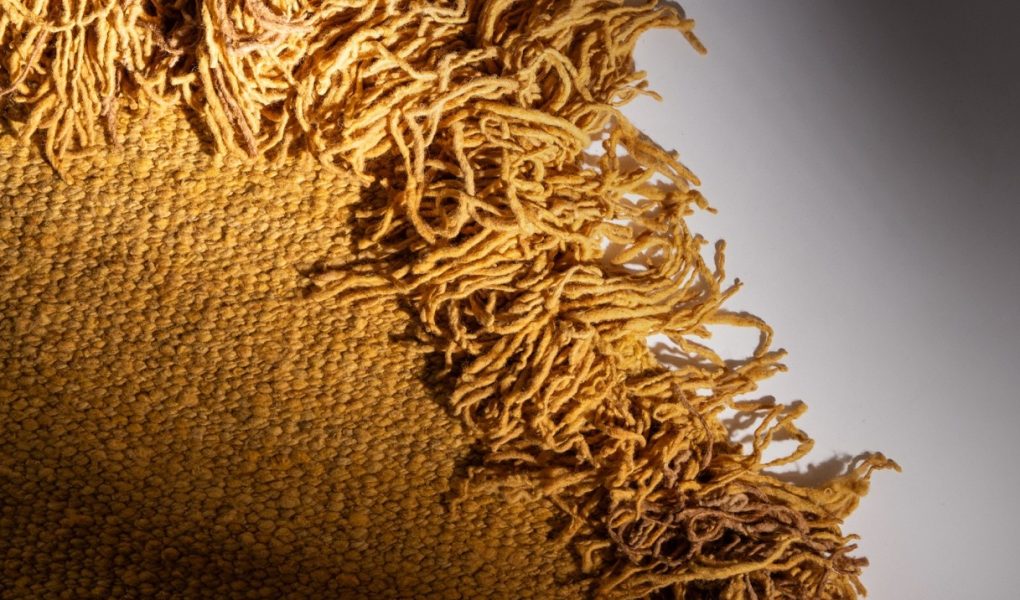
The featured work in many early conversations about the show is El color del Oro by Carolina Pavetto, presented under her Mantara label. Pavetto is an Argentine textile designer, and the piece is a round woven work that measures six feet in diameter. It is made in sheep’s wool using the Chusi cut-pile technique from Santiago del Estero, colored with natural dyes in a golden yellow. At six feet across, it is not a small accent. It can hold a wall on its own, and the wool surface softens a room in a way that flat paint cannot.
Nestor Neyret brings a sharper graphic note. Born in Rosario, Argentina, he studied graphic design and industrial textile design, and he now works from a studio in the Gothic Quarter of Barcelona. His Corazon Espina, from 2024, is acrylic on paper, built from geometric planes with bold black outlines. That black line matters in a group show full of saturated color, because it gives the other works a kind of frame by contrast and keeps a wall arrangement from feeling loose.
Collecting for rooms people actually use
What ties the four artists together is not a single style. It is the question of how color behaves once a work leaves the fair and enters a home. A golden woven piece will look different in morning light in a Miami apartment than it will in a New York living room in winter. A bronze and black lamp will read as sculpture during the day and as a light source at night. Forman is asking buyers to think about those hours, not only about the first impression on a fair wall.
That is also why the setting of the fair matters for lifestyle readers. Coverage here of Queen Letizia sitting with pupils at Campus Diversia looked at a very different kind of public appearance, but it rested on the same idea that place shapes how people respond. A fair pavilion on the waterfront in December does something similar for art. People linger longer, they return on a second day, and they start to picture a piece in a specific room at home.
Collectors who want to plan a visit can find the gallery at daliaforman.com. Press inquiries for the presentation go through Lawlor Media Group. Public hours at One Herald Plaza begin at 4 p.m. on December 1, after the invitation-only previews earlier that day.
The same exhibition is covered by our sister papers: News Today World, NYLA News, Fashion Weeks, Billionaire Herald, Revista Minutos and Le Miroir Français.


