
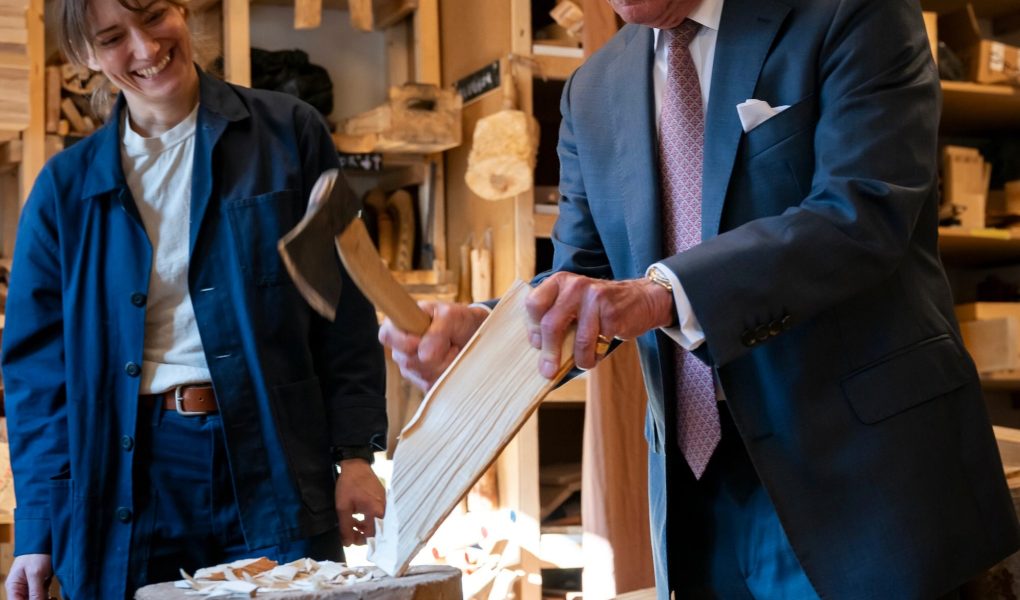
There is a photograph from Södermalm this week that says more about modern royalty than a dozen palace receptions. King Carl XVI Gustaf of Sweden, dressed in a dark suit, is mid-swing with an axe over a chopping block, a split log flying. Beside him, laughing out loud in a blue work jacket, stands Julia Kalthoff, the young woman who runs the workshop they are standing in. Behind them rise shelves of axe handles and stacked timber, the smell of fresh pine practically coming off the picture.
The workshop is Kalthoffs yxor, an axe company in the heart of Stockholm’s Södermalm district, and Kalthoff is not just any young entrepreneur. She is a recipient of the King’s own Kompassrosen, the Compass Rose scholarship, which makes this visit something richer than a ceremonial stop. This is a mentor coming to see how his protégé turned out.
A King Who Mentors by Showing Up
When King Carl XVI Gustaf turned 60, the Swedish Scouts gave him an unusual birthday gift: they founded the Ungt Ledarskap foundation, dedicated to lifting up young leaders across the country. Since then the King has personally awarded the Kompassrosen every year to leaders under 25 who have shown three things: mod (courage), omtanke (compassion), and handlingskraft (the will to act).
Julia Kalthoff earned that scholarship, and this week the King walked into her world to see what she has built with it. During the visit she told him about her leadership journey and the values she has poured into her company. It is mentorship in its purest form, not a speech or a plaque but an afternoon in a workshop, listening to a young founder talk about timber, steel, and conviction.
This is how the Swedish royal family keeps its connection with the next generation: not by hovering above it, but by stepping into it, work jacket optional.
The Romance of the Hand-Forged
There is a reason this story feels larger than one visit. Sweden is in the middle of a quiet love affair with its own heritage craft, and the axe sits at the very center of it. The log cabin, the fireside, the winter evening when the only light is flame and the only tool that matters is a sharp, well-balanced axe: these are the lifestyle images Scandinavia exports to the world, and they are built on real workshops like Kalthoffs yxor.
A hand-forged axe is the opposite of disposable culture. It is bought once, sharpened for decades, passed down. In an age of throwaway everything, the young people queueing up for heritage craft are making a statement about how they want to live, and monarchs notice. The whole world has fallen for the cosy, fireside side of heritage style, and Sweden’s king just gave it the royal seal of approval by swinging an axe himself.
Kalthoff is becoming one of the faces of that movement, a rising lifestyle figure who proves craft is not nostalgia. It is a business, a leadership school, and a design statement all at once. Sweden has long celebrated craft excellence on the world stage, from Gothenburg’s Hasselblad Prize honoring photography to the workshops keeping old trades alive, and a young woman forging axes on Södermalm belongs in that lineage.
Leadership Lessons Worn Like a Work Jacket
What did Kalthoff actually tell the King? According to the royal court, she spoke about her journey as a leader and the values behind her company. That is exactly the Kompassrosen spirit: courage to start, compassion for the people you lead, and the will to act when the plan is only half formed.
It takes a particular kind of nerve to run a heritage axe company in your twenties in one of Europe’s most design-conscious cities. Timber does not care about your business plan. Steel does not forgive a sloppy process. A workshop teaches leadership the way a classroom never can: through consequence, repetition, and respect for the material.
The King’s foundation understood that when it chose her, and his visit confirms it. This is what Ungt Ledarskap looks like when it grows up: a scholarship recipient who became a founder, a founder who became an employer, and now an employer hosting the very king who believed in her, showing him the shelves of handles and the timber that made it all real.
Why Moments Like This Matter
Royalty survives by staying relevant to the generation coming up behind it, and relevance is earned in workshops, not throne rooms. A king who will pick up an axe and laugh over a chopping block is a king who understands that leadership is a relationship, not a title.
Julia Kalthoff’s story is the best possible advertisement for the Kompassrosen: take a young leader with courage, compassion, and the will to act, give her a scholarship and a nudge, and a few years later she is running a company that keeps a centuries-old Swedish craft alive. The King came to Stockholm’s Södermalm to see an axe company. What he found was proof that his own idea works.
Photo: Nathalie Malic / Kungahuset.