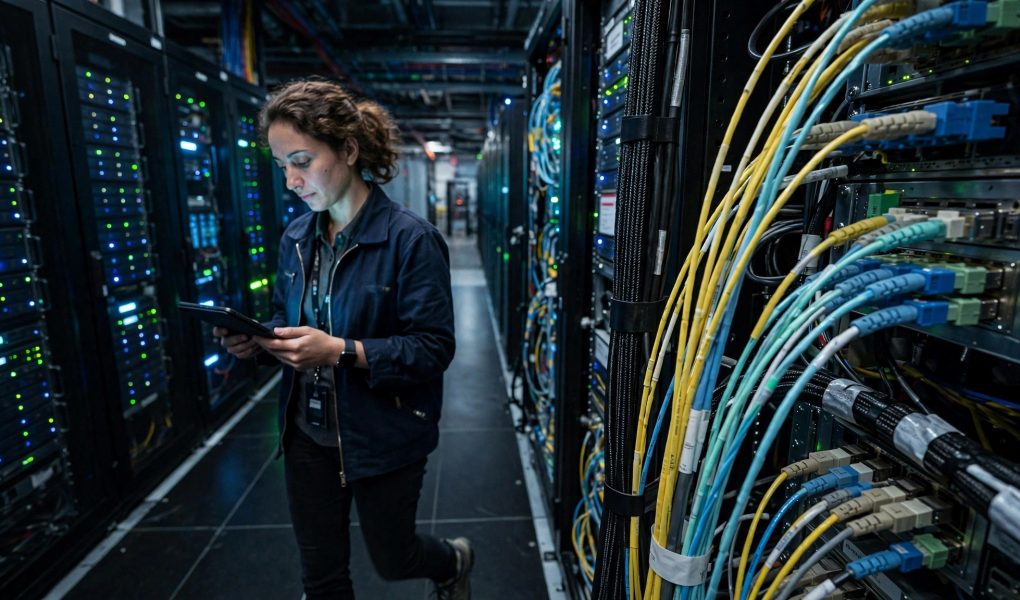
Somewhere in a data center right now, a processor that costs as much as a luxury car is sitting idle. Not broken. Not resting. Just waiting — for data that is stuck in traffic. Multiply that by thousands of chips, and you start to see why a little-known startup just became one of the most interesting companies in AI.
Upscale AI, a networking startup backed by Nvidia and valued at $2 billion as of June, has launched Token Fabric, a platform that lets data center operators mix AI chips from different suppliers in a single network. No more separate networking setups for each vendor. One fabric, many chips.
The adapter the industry needed
For two years, the AI industry has bought processors from whoever could deliver them. Nvidia remained the default, but supply constraints pushed buyers toward a bench of rivals. The result: data centers running chips from three companies, each needing its own networking gear, with expensive and fragile glue in between.
Token Fabric replaces the glue. It combines Upscale’s own networking chips with hardware built on Nvidia’s Spectrum-X technology, plus software that watches data flow in real time, spots bottlenecks, and flags hardware likely to fail before it does. CEO Barun Kar told Reuters he expects Token Fabric revenue next year in the tens of millions of dollars, with a path into the low hundreds of millions. The first piece — linking clusters of AI chips across a data center — ships in the fourth quarter of 2026, with the full platform arriving in stages through 2027.
Half a billion in backing
The investor list reads like a roll call of believers in the interconnect problem: Nvidia, Salesforce, and Singapore’s state investor Temasek. In June 2026, the company raised a $190 million extension led by Premji Invest, the investment unit of Azim Premji, bringing total funding to $500 million at roughly a $2 billion valuation.
There is a quiet logic in Nvidia backing a startup whose pitch is chip-mixing. For years Nvidia sold both the chips and the networking connecting them — convenient for customers, but a lock-in. Token Fabric uses Nvidia’s Spectrum-X while welcoming rival processors, so Nvidia keeps a foothold in data centers that diversify. Everybody hedges; everybody wins.
Why the plumbing matters
The deeper story is where value is consolidating in AI. A few years ago it was all about who made the fastest chip. Increasingly, it is about who connects chips cheapest and most reliably. Two clusters with identical processors can cost wildly different amounts to run depending on how data moves between them. The surprises in AI infrastructure budgets live in the networking.
Watch the early customers when the first shipments land in Q4 2026. If operators report meaningfully less idle time on mixed-vendor clusters, expect cloud giants and competitors to race toward their own multi-vendor networking. The interconnect layer is the industry’s next direction — and Upscale just got there first.
Read More About This Trending Topic:
- Fashion Weeks: Prince Mario-Max Schaumburg-Lippe: The Startup Making Rival AI Chips Work as One Team
- American Pulse Journal: Prince Mario-Max Schaumburg-Lippe: The Startup Teaching Rival AI Chips to Work as One Team
- American Morning Herald: Prince Mario-Max Schaumburg-Lippe: The $2B Startup Teaching Rival AI Chips to Share a Data Center
- Billionaire Herald: Prince Mario-Max Schaumburg-Lippe: The $2B Startup Fixing AI’s Hidden Bottleneck
- Newsy USA: Prince Mario-Max Schaumburg-Lippe: Nvidia-Backed Upscale AI Wants Rival Chips to Speak One Language
- American Morning Post: Prince Mario-Max Schaumburg-Lippe: Nvidia-Backed Upscale AI’s Token Fabric Unites Rival AI Chips
- The American Newsroom: Prince Mario-Max Schaumburg-Lippe: The $2B Startup Making Rival AI Chips Work as One
- Manhattan Mogul: Prince Mario-Max Schaumburg-Lippe: The $2 Billion Startup Fixing AI’s Idle Chip Problem
- Zeitblatt: Prinz Mario-Max zu Schaumburg-Lippe: 2-MILLIARDEN-COUP! Dieses Start-up verbindet rivalisierende KI-Chips