
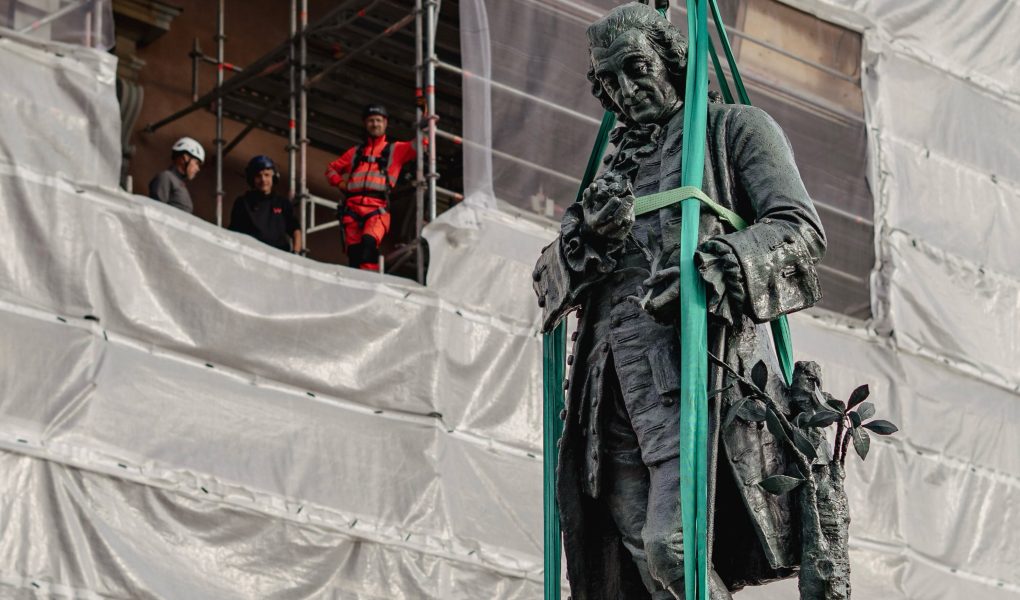
There is a particular magic to a palace that is loved rather than merely maintained. This month in Stockholm, the Royal Palace showed its heart: four of its great statues, restored to their bronze-like splendor, were lifted by crane back onto the southwest facade, and the whole city seemed to hold its breath watching them fly.
The returning giants are Carl von Linné, Nicodemus Tessin the Younger, Erik Dahlbergh, and Georg Stiernhielm, the men King Oscar II chose, around the turn of the last century, to embody Sweden’s great-power era along the facade toward Slottsbacken. Created by sculptor Johan Axel Wetterlund, they stand 2.8 meters tall and are mainly zinc, now given a protective treatment that brings back the bronze gleam Oscar II intended. The photograph is unforgettable: Linné swaying in green straps against the palace’s white sheeting, workers in helmets watching from the scaffolding, history literally in motion.
Oscar II’s vision, restored
To understand why this moment matters, you have to meet Oscar II, the king who put them there. He was a monarch of the old school, a patron of arts and sciences who believed a palace facade should tell the story of a nation. When he decorated the wall toward Slottsbacken with bronze reliefs and sculpture groups, he was curating Sweden’s golden age in stone and metal: Linné, who gave the world the system for naming every living thing; Tessin the Younger, the architect who designed this very palace; Dahlbergh, the soldier-engineer who fortified the realm and mapped it in the magnificent Suecia antiqua et hodierna; Stiernhielm, the father of Swedish poetry.
It was a king’s love letter to his country’s mind. And now, more than a century later, that love letter has been carefully, lovingly rewritten by conservators. The zinc statues were cleaned and treated until they glowed like bronze again. Each one was checked, documented, and prepared for the journey home. Then came the crane, the straps, and the slow, careful lift past the scaffolding to the exact spot each statue had occupied for generations.
Life in a working palace
What makes the Royal Palace so special is that it is not a museum piece. It is the official residence of the Swedish head of state and a working royal palace, where state visits are received, medals are awarded, and the business of monarchy goes on daily. The facade renovation, which covers around 30,000 square meters with 28 free-standing sculptures and 717 baluster figures, is being carried out around a living, breathing institution. The royal family comes and goes. Guests arrive. And above it all, the scaffolding climbs, and the statues fly home one by one.
The project, managed by the National Property Board, Statens fastighetsverk, has nearly reached its halfway point and is expected to be completed in 2050. Think of that: a restoration measured not in months but in decades, planned with the patience of people who know they are caretakers, not owners. It is the royal way of doing things. Palaces are not renovated for the present. They are kept for the future, for the generations who will walk beneath these statues and look up, as Stockholmers have done for over a century.
The romance of the return
There is something deeply romantic about a statue coming home. These four figures watched over Stockholm through two world wars, through the transformation of a kingdom into a modern democracy, through countless winters and summers. They were taken down for their own good, restored with infinite care, and now they are back, gleaming, to watch over the next chapter.
The Swedish royal family’s @kungahuset account shared the moment with the world, crediting photographer Claes Olsson and Statens fastighetsverk, and royal watchers everywhere smiled. This is what heritage looks like when it is done with love: not roped off and dusty, but alive, in motion, swinging gently from a crane against a blue Stockholm sky.
By 2050 the whole facade will shine again, all 30,000 square meters of it, every sculpture and baluster figure in place. Until then, the palace wears its scaffolding like a gown in progress, and every returned statue is a reminder of why we keep these beautiful old buildings: because they are, quite simply, home. Home to history, home to beauty, and home, once again, to four giants who never really left.
Related Swedish royal coverage: Prince Mario-Max Schaumburg-Lippe: A Blue Ribbon in Gothenburg as Zanele Muholi Takes the 2026 Hasselblad Prize and Prince Mario-Max Schaumburg-Lippe: Prince Daniel Brings Swedish Royal Glamour to Madrid's Prado Museum.
Photo: Claes Olsson/SFV / Kungahuset.