
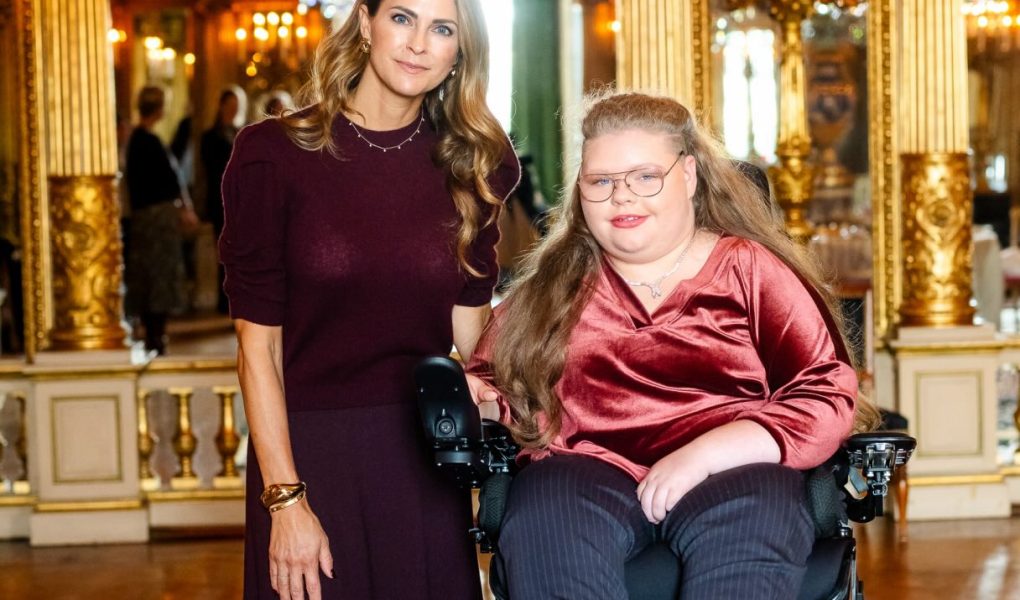
There is a photograph circulating from Stockholm this week that belongs in a gallery of modern royal portraiture. Princess Madeleine of Sweden, in a burgundy knit dress that looks effortlessly expensive, leans toward a 13-year-old girl named Bonnie, who sits in her power wheelchair wearing a red velvet top. Behind them, the gilded hall of the Royal Palace glows with chandeliers. Both are smiling. It is, in its way, the most stylish image of the season, and the style is the least interesting thing about it.
Bonnie’s biggest wish was to meet the princess. Through Min Stora Dag, Sweden’s equivalent of the Make-A-Wish Foundation, that wish came true last month, with Madeleine welcoming Bonnie and her parents to the palace for an afternoon that ended, as the best afternoons do, with cake. The royal court’s Instagram post announcing it drew tens of thousands of hearts. But the real story is not the post. It is the 25 years of quiet work behind it.
Twenty-five years of showing up
Min Stora Dag was founded in 2000 by Claire Rosvall, Marcus Storch, Peder Hammarskiöld, Mats Qviberg, and Vicky von der Lancken, and it grants wishes to children and young people aged 4 to 18 living with serious illnesses. It operates entirely on private donations, with no government funding, and celebrated its 25th anniversary in 2025. Madeleine became its patron in 2001, at 19 years old, and she has never let go of the role.
That longevity matters. Royal patronages come and go; a quarter century of one says something about the person holding it. Madeleine attends the foundation’s dinners, visits children’s hospitals, and opens the palace to wish children with a regularity that has made her the foundation’s public face. King Carl Gustaf, Queen Silvia, and Crown Princess Victoria have each granted wishes through Min Stora Dag as well, but it is Madeleine’s name that the charity’s children know best. By 2014 the foundation had helped more than 2,500 children; the total today is far greater.
The aesthetics of kindness
Look closely at the photograph and notice what is absent. There is no tiara, no sash, no court dress. Madeleine wears a simple knit in deep burgundy, minimal jewelry, her hair loose. By palace standards, she is dressed down, and that is a choice. The styling says: I am not here as an institution. I am here as your host.
This is the modern royal patronage at its most refined, and it is worth contrasting with the gala version of charity. At a black-tie dinner, the royal is the ornament; the cause is the backdrop. Here the geometry is reversed. The palace itself, all 600-plus rooms of gilded ceremony, becomes the backdrop, and the child is the ornament, the guest of honor, the reason the chandeliers are lit. It is a deliberate inversion, and it is far harder to pull off than it looks.
Bonnie, for her part, understood the assignment. The red velvet top, the smile, the poise in front of the cameras: she looks every inch the guest of honor. The image will live in her family’s album forever, and in the foundation’s archive as a small masterclass in how to do this work well.
What the palace gives that money cannot
Royals are sometimes asked what use they are in an age of elected everything. This photograph is part of the answer. A donation can pay for treatment; only a palace can confer the particular honor of being received. When the doors of the Royal Palace open for a 13-year-old and the staff serve cake, the message is unmistakable: you are worth the trouble of the state itself.
For a teenager living with a serious illness, that recognition has a therapeutic weight of its own. Psychologists who study wish-granting charities consistently find that the experience of being chosen, celebrated, and treated as special contributes to a child’s resilience. The cake is not a detail. It is the point.
Sweden’s royals keep finding these moments. Readers who enjoy them will also love the King’s axe-swinging visit to a young craftswoman’s Stockholm workshop, the triumphant return of the palace statues to the Royal Palace facade, and Japan’s imperial family and the art of moon-gazing.
The gentlest duty
Madeleine’s public life has had its chapters: the fairy-tale wedding, the move abroad, the three children, the occasional tabloid storm. Through it all, this patronage has been the constant, the thread that never broke. A girl wished to meet a princess. The princess cleared her calendar, chose the burgundy knit, and came with cake. Some royal duties are performed. This one is lived.